Every Ant Royale campaign begins with a small colony, a few workers, and limited food. Your workers forage automatically, but you decide what the colony becomes: a productive food network, a defended stronghold, or the starting point of a growing army.
The key is balance. Soldiers help you survive raids and capture rival nests, but they cost food to train and maintain. Workers and Granaries keep your economy moving, while Barracks and nest upgrades give you room to grow. Expand too slowly and rivals gain strength; expand too quickly and your empire may become difficult to defend.
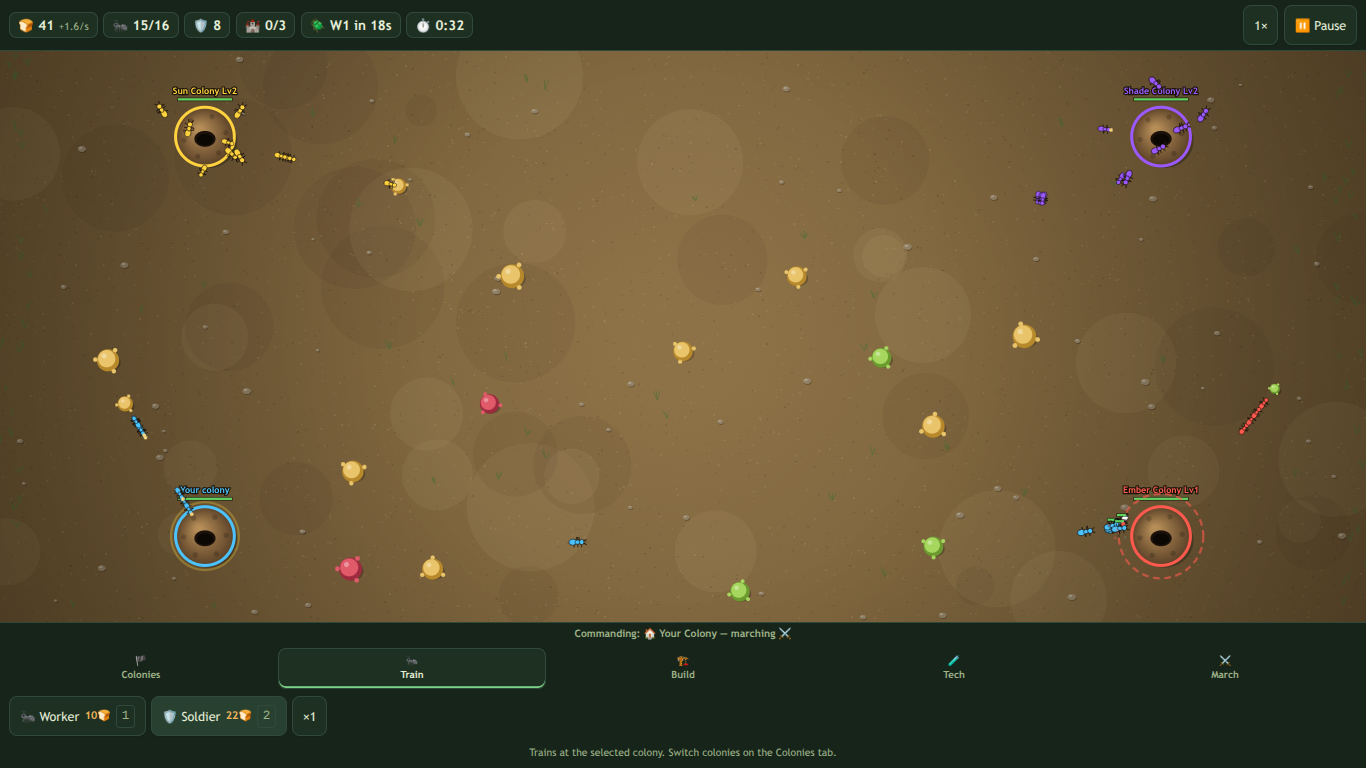
Choose your campaign
Ant Royale offers two ways to build your empire. Pick the one that suits your pace—or try both.
A focused campaign on a fixed map. Capture all three rival colonies to win, while keeping your main nest safe from raids and pest waves.
Explore an endless, procedurally generated world. Your progress autosaves, rival empires expand, and you lose only when every colony you own has fallen.
The basics: build a healthy colony
- Keep food coming in. Workers collect food automatically. More workers and better Foraging research can help your colony gather resources faster.
- Grow within your population cap. Deepen your main nest or build Barracks to increase the number of ants your empire can support.
- Prepare a defense. Keep soldiers near vulnerable colonies. Watchtowers attack nearby foes, and Walls add health to the nest they protect.
- Choose a target. Select one of your colonies, gather its soldiers, then march on a rival nest when you’re ready.
- Put captured colonies to work. A captured nest gives you another place to train and build, plus passive food income.
Food is the foundation of your empire
Food pays for workers, soldiers, research, and buildings. It also supports your soldiers over time: upkeep rises with the number of soldiers and colonies you own. That means a large army can become a burden if your food economy hasn’t grown alongside it.
Economy tips
- Invest in workers early. Workers are often a strong early investment because they gather the resources that fund every other part of your strategy.
- Research Foraging for long-term value. Each level increases worker carrying capacity and speed, helping your workers bring food home more efficiently.
- Use Granaries where income matters. A Granary provides passive food income at the colony where it is built. You can build them at your main nest or captured colonies.
- Don’t spend your entire reserve. Keep enough food available to respond to a raid, replace losses, or train troops for a promising attack.
Choose buildings for the job
Buildings are constructed separately at each colony, so think about what each location needs. A forward colony near enemy territory may need defenses, while a safer colony can focus on recruitment or income.
- Barracks: Increase your population cap and reduce troop costs at that colony. Useful when you want to recruit and reinforce an army from a particular location.
- Granary: Adds passive food income at the colony where it is built. A practical choice for strengthening your economy.
- Wall: Adds nest health. Consider reinforcing colonies that are exposed to attacks or important to your expansion.
- Watchtower: Automatically attacks nearby enemies. It can help defend a colony without requiring you to issue an attack order.
March with a plan
Tap one of your colonies to select it. Tap an open area of the map to rally its ordered soldiers, or tap a rival nest to send them to attack. The March controls let you choose what share of the colony’s soldiers follows your orders: all, 75%, 50%, or 25%.
Combat and capture strategies
- Assemble before you attack. Rally soldiers at a safe location so they can reach the target together rather than arriving in a trickle.
- Leave a home guard. Sending every soldier away can make a colony vulnerable to pests or rival raids. Use a smaller march percentage when you need defenders to stay behind.
- Use Recall when the situation changes. Recall brings a colony’s ordered soldiers home. It’s useful when a defense matters more than continuing a distant march.
- Capture to expand your options. When a rival nest is captured, you gain food and its workers join you. The colony can then support local training and construction.
- Don’t ignore rival growth. Rival colonies can train troops and improve over time, so delaying every attack may make later battles harder.
Open World: expand carefully
Open World adds exploration, rival empires, and threats across a huge map. Drag to move the camera, use the arrow keys, or tap the minimap to jump to another area. Press C to center the view on your active colony.
- Explore with a purpose. Look for nearby colonies, food, and routes for expansion instead of wandering without a target.
- Build a connected empire. Each colony offers another place to recruit and build, but distant outposts may be harder to defend.
- Balance conquest and defense. A new colony increases your reach and income, but your empire also needs soldiers and food to hold its territory.
- Prepare for Fire Ants. Once your empire grows beyond 20 colonies, Fire Ant swarms can appear in pest waves. These stronger enemies can capture colonies, so keep vulnerable locations protected.
- Use the minimap to stay oriented. It shows discovered nests and your current camera position, making it easier to navigate a large empire.
Quick controls
On touchscreens, use the on-screen controls and tap the map to give orders. In Open World, drag the map to explore.
A simple strategy to remember
Build your food supply first, expand your population cap when you need it, and recruit soldiers in a way your economy can support. Keep defenders at home, rally before major attacks, and use captured colonies to strengthen your empire. There’s no single perfect plan: adapt your balance of workers, soldiers, and buildings to the threats around you.